Knowledge · Research paper
Isness: Using Multi-Person VR to Design Peak Mystical Type Experiences Comparable to Psychedelics
By David R. Glowacki, Mark D. Wonnacott, Rachel Freire, Becca R. Glowacki, Ella M. Gale, James E. Pike, Tiu de Haan, Mike Chatziapostolou, Oussama Metatla
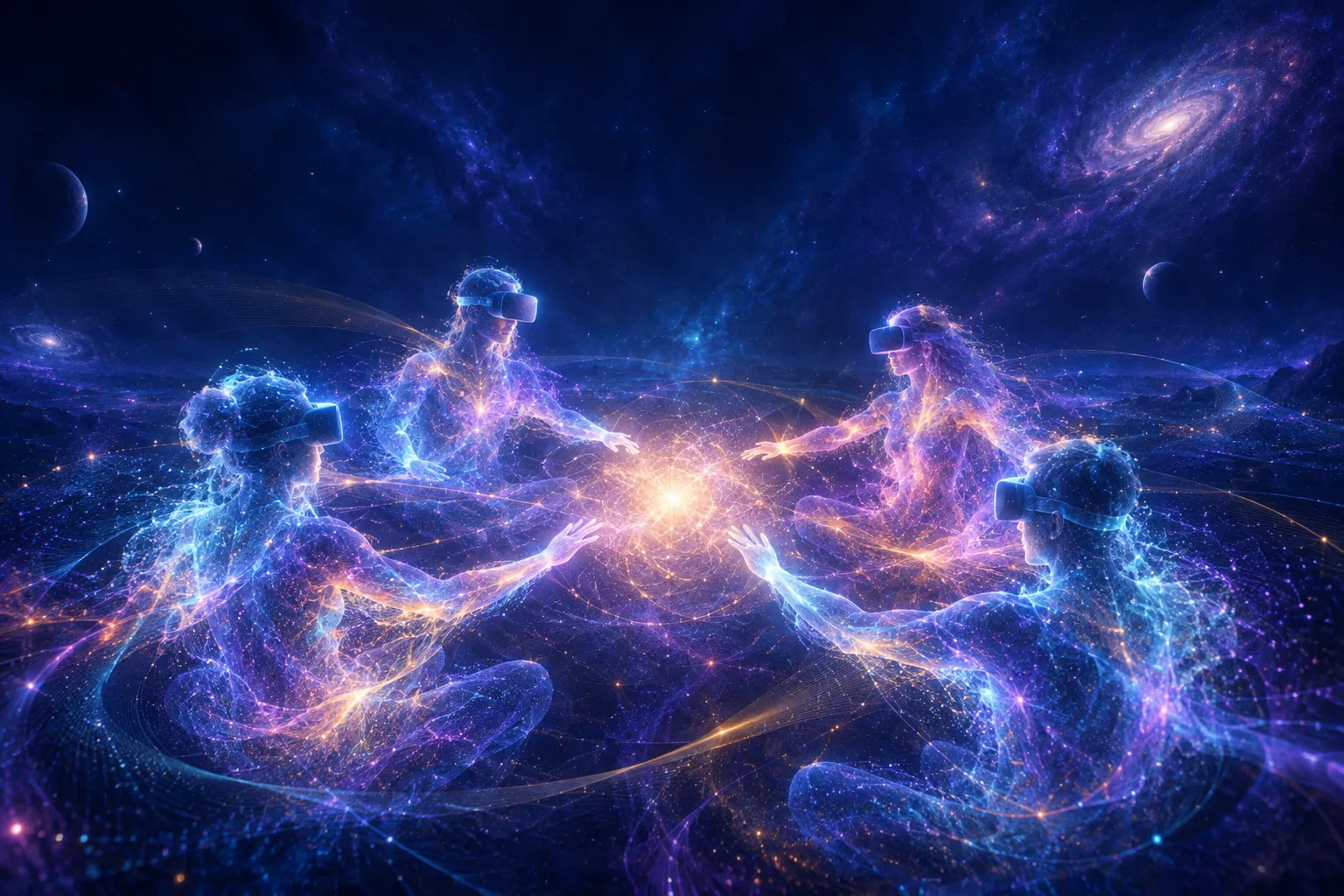
This open-access CHI 2020 research article evaluates Isness, a multi-person VR journey in which participants experience their bodies as collective energetic essences. In a study of 57 participants using the MEQ30, reported mystical-type experiences were comparable to those in published high-dose psilocybin and LSD studies. The paper presents VR phenomenology as a possible route to connectedness, transcendence, and ineffability within a supportive setting; this is a comparison study, not evidence that VR pharmacologically reproduces psychedelics.
- Kind
- Research paper39 research papers in the bank
- Published
- 2020Where it sits among everything in the Knowledge Bank, by year
- Authors
Topics
Abstract
About the paper
This open-access CHI 2020 research article evaluates Isness, a multi-person VR journey in which participants experience their bodies as collective energetic essences. In a study of 57 participants using the MEQ30, reported mystical-type experiences were comparable to those in published high-dose psilocybin and LSD studies. The paper presents VR phenomenology as a possible route to connectedness, transcendence, and ineffability within a supportive setting; this is a comparison study, not evidence that VR pharmacologically reproduces psychedelics.
Studies combining psychotherapy with psychedelic drugs (Ds) have demonstrated positive outcomes that are often associated with 'Ds' ability to induce 'mystical-type' experiences (MTEs) i.e., subjective experiences whose characteristics include a sense of connectedness, transcendence, and ineffability. We suggest that both PsiDs and virtual reality can be situated on a broader spectrum of psychedelic technologies. To test this hypothesis, we used concepts, methods, and analysis strategies from D research to design and evaluate 'Isness', a multi-person VR journey where participants experience the collective emergence, fluctuation, and dissipation of their bodies as energetic essences. A study (N=57) analyzing participant responses to a commonly used D experience questionnaire (MEQ30) indicates that Isness participants reported MTEs comparable to those reported in double-blind clinical studies after high doses of psilocybin and LSD. Within a supportive setting and conceptual framework, VR phenomenology can create the conditions for MTEs from which participants derive insight and meaning.
Related
More like this
Autonomic indicators of self-transcendence: insights from the numadelic VR paradigm
HRV amplitude is identified as a physiological marker of self‑transcendent experiences during a “numadelic” VR paradigm, showing links to subjective self‑transcendence, compassion traits, and emotional improvement, though the study does not establish general clinical efficacy or long‑term effects.
Six Psychonauts on VR, Psychedelics, & Consciousness Transformation
Six psychonauts explore how virtual reality and psychedelics may transform consciousness, touching on altered states, phenomenology, culture, philosophy, and technology.
Invoking Psychedelic Embodiment Experiences in VR with Radix Motion’s “MEU” Asynchronous Communication Platform
Kent Bye’s XR taxonomy offers a working map of the diverse, evolving industry and a springboard for conversation, while acknowledging that no single framework can fully capture the range of human experiences.
- Editor
- Not recorded yet
- Last reviewed
- Not reviewed yet
Conversation
Share your experience of it
What it was like, what helped, what you would tell someone before they try it.